
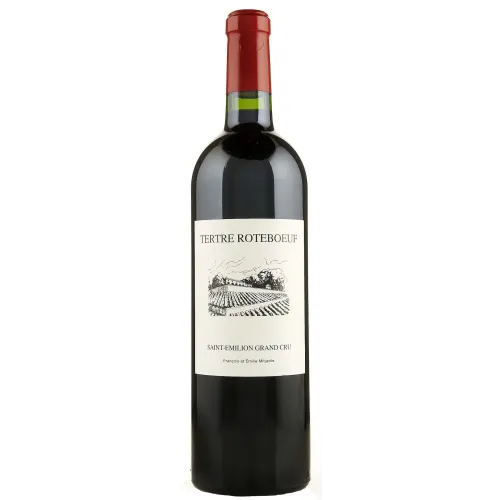
2021 Château Tertre Roteboeuf Saint-Émilion Grand Cru
Code: 1954779
· In Stock
$389.98
Select Your Options:
| $389.98 |
Delivery details
Enter destination to see dates & costs
- Description
François Mitjavile, the philosophical gentleman farmer of Saint-Émilion, continues to produce some of Bordeaux’s most distinctive and characterful wines from his 5.6-hectare amphitheatre-shaped vineyard on the south-facing clay-limestone slopes of Saint-Laurent-de-Combes. A passionate and charismatic man who works differently from everyone else, François refuses to participate in the “Bordeaux circus,” as he calls it. Mitjaville’s Merlot and Cabernet Franc fruits are cordon-pruned and trained almost impossibly low to the ground, and are harvested as late as possible, in a quest for what he describes as the “luxuriant breakdown” of the tannins. The vinification is in some ways rather old-fashioned, with fairly warm fermentations and maturation in new barrels (from Tonnellerie Radoux) in a cellar that fluctuates in temperature with the seasons, with no temperature control. His belief is that, as he puts it, “the most original wines are also, paradoxically, the most traditional.” Above all, Mitjavile abhors primary, monolithic wines, instead admiring aromatic complexity and textural sensuality; and Tertre Roteboeuf exemplifies these priorities, with its rich aromas marrying ultra-ripe yet always surprisingly vibrant fruit notes with a rich patina of secondary and tertiary nuances. Their ageing trajectory can be as unique as their style: sometimes, vintages that seem tired can find new life a decade later, and while Tertre Roteboeuf often seems quite mature and young, it often seems unusually youthful when old. The Mitjavile family also owns Domaine de Cambes and Roc de Cambes on the Right Bank. As with Tertre Roteboeuf, the wine here is made with a priority on fruit expression and harmonious freshness. Le Tertre Rotebœuf 2021 is another impressive creation from the Mitjaville family, a wine that continues to be admired by enthusiasts and critics alike. In this vintage, the wine once again displays its characteristic elegance and intensity. In the glass, a seductive bouquet of blackcurrants, ripe blackberries and cherries unfolds, interwoven with subtle notes of violets, cigar box, sweet spices and an earthy, loamy undertone. On the palate the wine is full and layered, with a deep fruit core, silky tannins and lively acidity that provide tension and freshness. The wine is still young, but promises a brilliant development in bottle, with at least a decade or more of aging potential. FACT: In the tab 'Attachments' you will find the official fact sheet of this beautiful wine. We will automatically send you this when you order this wine. The wine is in our conditioned Wine Warehouse and if you come to pick up the wine you will often also receive a nice discount . You will see your discount immediately when you choose 'Pick up' on the checkout page. We are located in Dordrecht almost next to the A16 with plenty of parking. Click here for our address. You can read the full wine reviews from Parker, Suckling, Vinous and Wine Spectator via the links next to the image. A free service for our customers. Need advice on finding the perfect wine for your dish? Click here for our exclusive Sommelier. Free for customers. 1. Beef tenderloin with truffle jus and parsnip puree Tender beef tenderloin complements the silky tannins, while the truffle and parsnip enhance the wine's earthy and floral notes without dominating. 2. Mushroom risotto with Parmesan and thyme The creamy texture of the risotto mirrors the velvety texture of the wine, and the earthy umami of mushrooms harmonizes beautifully with the ripe fruit and spicy notes 3. Roasted quail with grapes and sage Poultry with slightly sweet, caramelised elements and spicy accents provides a soft transition between the freshness of the wine and its concentrated fruit core. 4. Polenta with beef stew and black olives The full, concentrated flavours of braised beef complement the depth of the wine perfectly, while the polenta supports the layering without adding t