
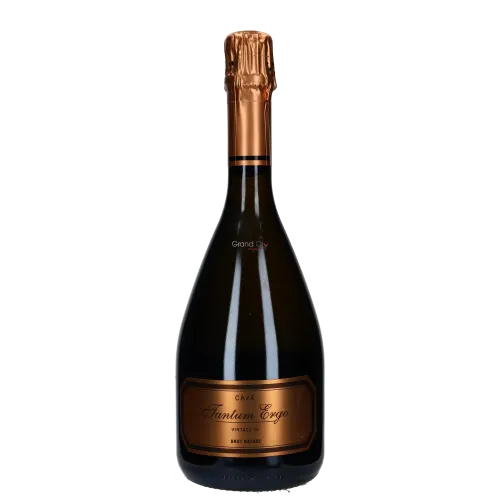
2020 Hispano Suizas Tantum Ergo Vintage Brut Nature
Code: 1954815
· In Stock
$89.98
Select Your Options:
| $89.98 |
Delivery details
Enter destination to see dates & costs
- Description
The Tantum Ergo is Hispano-Suizas' top-of-the-line wine and an internationally acclaimed flagship. It's one of the Cavas made from the exact same grapes as Champagne: Chardonnay and Pinot Blanc (Blanc de Noir), a rare find in the Cava region. The wine is also made using the Traditional method, with double fermentation, so it can rightly be called a "Spanish Champagne." We're up for the challenge, as Suckling and Decanter, among others, agree. Try the Vintage Cavas from Hispano-Suizas (blind) alongside a good champagne and you'll see for yourself. So incredibly good, with impressive perlage. So fine that the bubbles are barely visible, yet on the palate, they are so wonderfully refined, revealing all the fresh fruit. For the flagship version of this quintessential Spanish "Champagne," they select the finest grapes from low-yielding vines in their own Chardonnay and Pinot Noir vineyards, which contain only 3,500 plants per hectare. The grapes are collected in special 15 kg boxes. Harvesting takes place only in the very early morning to maintain the optimal temperature for the grapes until they reach the winery. Once in the winery, the full boxes are stored in cold rooms at -10°C for three days. The grape varieties are vinified separately, and at the end of fermentation, the grapes are separated. The Chardonnay is destemmed and crushed, after which the grape pulp is placed in stainless steel tanks with a cooling system for cold maceration at 8°C for 36 hours. The Pinot Noir is cold-pressed in a pneumatic press, using a gentle pressure of no more than 0.5 bar to obtain the white grape juice. The grape juice is left to stand for 36 hours, after which only the clear portion is fermented. Fermentation takes place in new 400-liter American oak barrels at a temperature of 16°C. After fermentation, the wine remains on the lees (the lees) until the final filtration. The second fermentation takes place in the bottle at a constant temperature of 16°C to promote very slow fermentation, resulting in perfect carbonation, visible in the very fine bubbles in the glass. Maturation on the lees lasts for at least almost four years, and disgorging is done manually. In the glass, this top-quality wine has a golden yellow color with a green tinge at the edges. On the nose, the Tantum Ergo Vintage is highly intense, revealing a multitude of aromas as the wine opens up in the glass. It is highly complex and elegant, with hints of ripe fruit, dried fruit, and a background of vanilla and butter, along with yeasty notes from aging. Despite its low sugar content (ultra-brut), the palate is very creamy, full-bodied, and elegant, with beautifully balanced acidity and a very long palate. ABOUT CAVA & HISPANO SUIZAS Cava has been a protected designation of origin since 1972. The name cava first officially appeared in 1959; before that, the Spanish simply called it "champán." The production process is therefore identical to that of champagne. Historically, the monk Dom Pérignon, the "inventor" of champagne, even got the idea of using a cork with a muselet to seal the bottle while visiting Catalonia. Cava production is carried out according to the standards of the "méthode traditionnelle" (traditional method), identical to champagne production, with two key differences: the region or terroir where the grapes grow and, above all, the grapes used. CAVA production indeed still takes place mainly in what is today the territory of the DO Penedès, but there are now also many other regions where cava can be made and which also legally belong to the Cava appellation. And near Valencia there is also a small unique area that belongs to the DOP Cava. It differs from this region near Penedes (Barcelona) in that it has a continental climate with Mediterranean influences, and the soils consist primarily of calcareous clay. Another difference is that the vineyards are situated a few hundred meters above sea level and still have to work hard to find water and minerals f