
Crocus Flower - from Iridaceae Family
Published · GiftBlooms · Flower Resource
 The name of the genus is derived from the Latin word crocatus that means saffron yellow. Saffron is actually a spice that is derived from the flower of saffron crocus and it is a species of crocus that is from Iridaceae family. Crocus is native to Southern Europe and Asia. There are about 80 species of Crocus, out of which only 30 are cultivated. The cup shaped, solitary and salve form flowers taper off into a narrow tube and the saffron comes from the stigma of Saffron Crocus.
In the language of flowers the meaning of Crocus is cheerfulness and youthfulness. So you can gift these flowers to your near and dear ones for various happy occasions and festivals and convey your greetings through these lovely flowers.
The name of the genus is derived from the Latin word crocatus that means saffron yellow. Saffron is actually a spice that is derived from the flower of saffron crocus and it is a species of crocus that is from Iridaceae family. Crocus is native to Southern Europe and Asia. There are about 80 species of Crocus, out of which only 30 are cultivated. The cup shaped, solitary and salve form flowers taper off into a narrow tube and the saffron comes from the stigma of Saffron Crocus.
In the language of flowers the meaning of Crocus is cheerfulness and youthfulness. So you can gift these flowers to your near and dear ones for various happy occasions and festivals and convey your greetings through these lovely flowers.
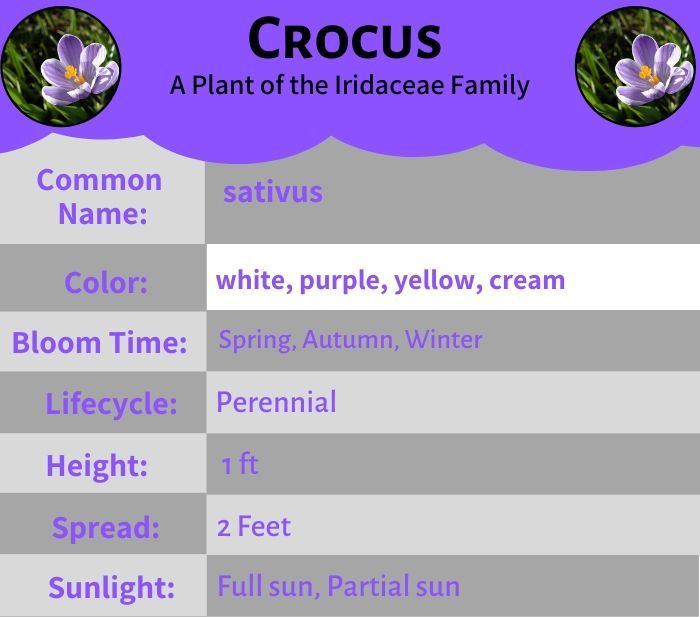
Uses of Crocus Flower
- The three stigmas of the flowers and parts of its styles are usually dried and used in cooking as coloring and seasoning agent.
- Saffron has medicinal applications.
- The ancient Greeks used these flowers to ward off the fumes of liquor by weaving these flowers into the wreaths for head.
Interesting Facts
- Saffron has been world’s most expensive spice by weight.
- Saffron is native to Southwest Asia and it was cultivated in the vicinity of Greece.
- The odor of the Saffron is sometimes described as Sea air.
- The recommended varieties of this plant are Bowles White, Flower Record, Pickwick, Tricolor Crocus, and Purpureus Grandiflorus.
Soil Needed
- It can do best in full sun and grown in well drained soil that is moderately rich in organic matter.
- Bulbs will rot in soggy, compacted ground.

How to plant?
- You must plant crocus corms before the ground freezes in fall and they can be planted anywhere except in the dense shade on the north side of building or under thickets.
- You have to plant the corms 4 inches deep and 4 inches apart and in groups or clusters rather than in borders.
- These plants do not require heavy fertilizing; you can apply a light dusting of bone meal on soil each fall so that it can work during winter months.
- When you plant them in September or October you can see flowers appearing in the first fall and they last about 3 weeks.
- Propagation can be done through natural increase of corms that would multiply rapidly in rich soil.
Maintenance and Care
- These plants once planted will look after themselves and come up flowering year after year.
- If you have planted these plants in borders, the treatment given to those plants will benefit the crocus, so no individual treatment is required.
- Do not mows over the bulbs instead let them die down naturally after flowering; this is not usually a problem unless they are in groups rather than random scatterings.
- Remove mulches from snowdrops and crocuses so that the shoots can come through.
- In March you can keep plastic milk jugs or any other covering to protect the flowers of crocuses.